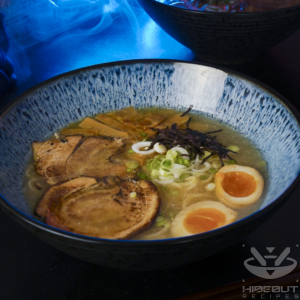
Tonkotsu Ramen 🍜
A deep and intense pork broth that needs a full day of boiling for ideal results.
Servings: 4 bowls
Equipment
- 1 very large pot with a lid
- 1 large mesh strainer for straining the broth
- 1 additional medium to large pot for straining the broth into
- 1 fine-mesh skimmer
Ingredients
Broth
- 1.5 kg pork bones legs or back
- 600 g pork hock with skin
- 3 l water
- 1 head garlic
- 1 knob ginger large
Dashi
- 500 ml water
- 1 sheet kombu
- 2 shiitake mushrooms dried
- 5 dried anchovies or some katsuobushi
Tare
- 2 tbsp sake
- 2 tbsp mirin
- 4 tbsp soy sauce light
- 2 tbsp water
- 1 sheet kombu
- 25 g salt
Seasonings
- 1 onion medium
- 2 green onions
- 10 g katsuobushi
- 2 tbsp sake
- 2 tbsp rice vinegar
Instructions
Make the broth
- Rinse the bones and pork hock under running water.
- Soak them in a bowl of water for a total of 15 minutes, replacing the water completely every 5 minutes.
- Peel the outermost layer off your head of garlic, then cut the entire head in half crosswise.
- Slice the ginger into thin slices. No need to peel.
- Place the cleaned bones, garlic, and ginger into a very large pot and add 3 liters of water. The ingredients should be fully submerged.
- Set to high heat and keep the lid off for now.
- Once it boils, reduce the heat to medium-high and keep at a rolling boil.
- Remove the scum using a fine-mesh skimmer. You'll need to do this multiple times (over the first half hour or so) before it stops gathering at the surface.
- The broth takes about 8 hours from here on out, but you need to check back regularly. Make sure that the broth is boiling (not just simmering) for a majority of that time.
- Once about 40% of the liquid has evaporated, cover the pot with a lid and turn the heat down a little. If you overshoot, you can top up with some water until the bones are fully covered again (but try to avoid this).
- Start the dashi cold brew (next steps) right after you started the broth. The tare and additional seasonings don't need to be ready until the 8 hours are up.
Cold brew the dashi
- Add the kombu, dried shiitake mushrooms, dried anchovies, and 500 ml of water to a small bowl.
- Keep at room temperature while your soup stock boils.
Make the tare
- Combine sake, mirin, soy sauce, kombu, and water in a small pot.
- Set to medium heat. Once it simmers, reduce to low and keep simmering for 3-4 minutes.
- Add the salt and stir well until it's fully dissolved.
- Set aside at room temperature.
Prepare seasonings
- Cut the onion in half and slice off the root end. No need to peel.
- Also cut the green onions in half crosswise.
Combine everything
- After the 8 hours are up, remove the lid. Make sure it's at a rolling boil throughout the remaining steps.
- Add the halved onion and green onions, rice vinegar, and sake to the pot.
- Take the shiitake mushrooms and anchovies out of your dashi cold brew and add them to the broth.
- Add 10 g katsuobushi and keep boiling for 30 minutes.
- Now add the dashi liquid (without the kombu) to the pot and boil for another 30 minutes.
- Careful not to let too much liquid evaporate. You want about 450 ml of broth per bowl (1.8 l for 4 servings), so put the lid back on the pot for the remaining time once you're in that ballpark.
Strain the broth
- I recommend putting your ramen bowls as well as the prepared toppings into the oven now and setting it to 75°C so they're all warm and ready to go in time.
- Take out another medium to large pot to strain the broth into and place a large mesh strainer on top.
- Take the solids out of the broth and squeeze them on the strainer (e.g. using a spatula) in order to extract the liquid into the new pot. Do this in small batches.
- Finally, pour the broth through the strainer, and squeeze any remaining solids that get caught in it.
Assemble
- Heat up the desired amount of broth servings (450 ml per person) in a pot and keep at a low simmer.
- Bring salted water to a boil for your noodles. I recommend keeping the servings separate by using one pot per serving.
- Take out the bowls and add 1 tbsp tare to each one.
- Add 450 ml of broth to each bowl.
- Boil your fresh ramen noodles. I recommend staggering them by a minute so they're not done exactly at once.
- Carefully add a serving of noodles to each bowl. If you want a nicer presentation, pull them out of the broth from the middle using chopsticks, then lay them down to the side so they're aligned in one direction.
- Add the ramen toppings of your choice and serve immediately.